Hassan Rasheed, home

Hassan Rasheed

Forward Deployed Engineer · Cologne, Germany

I build agentic AI and data platforms. Before that I spent a few years teaching machines to match what they see, from phishing pages to brain scans.

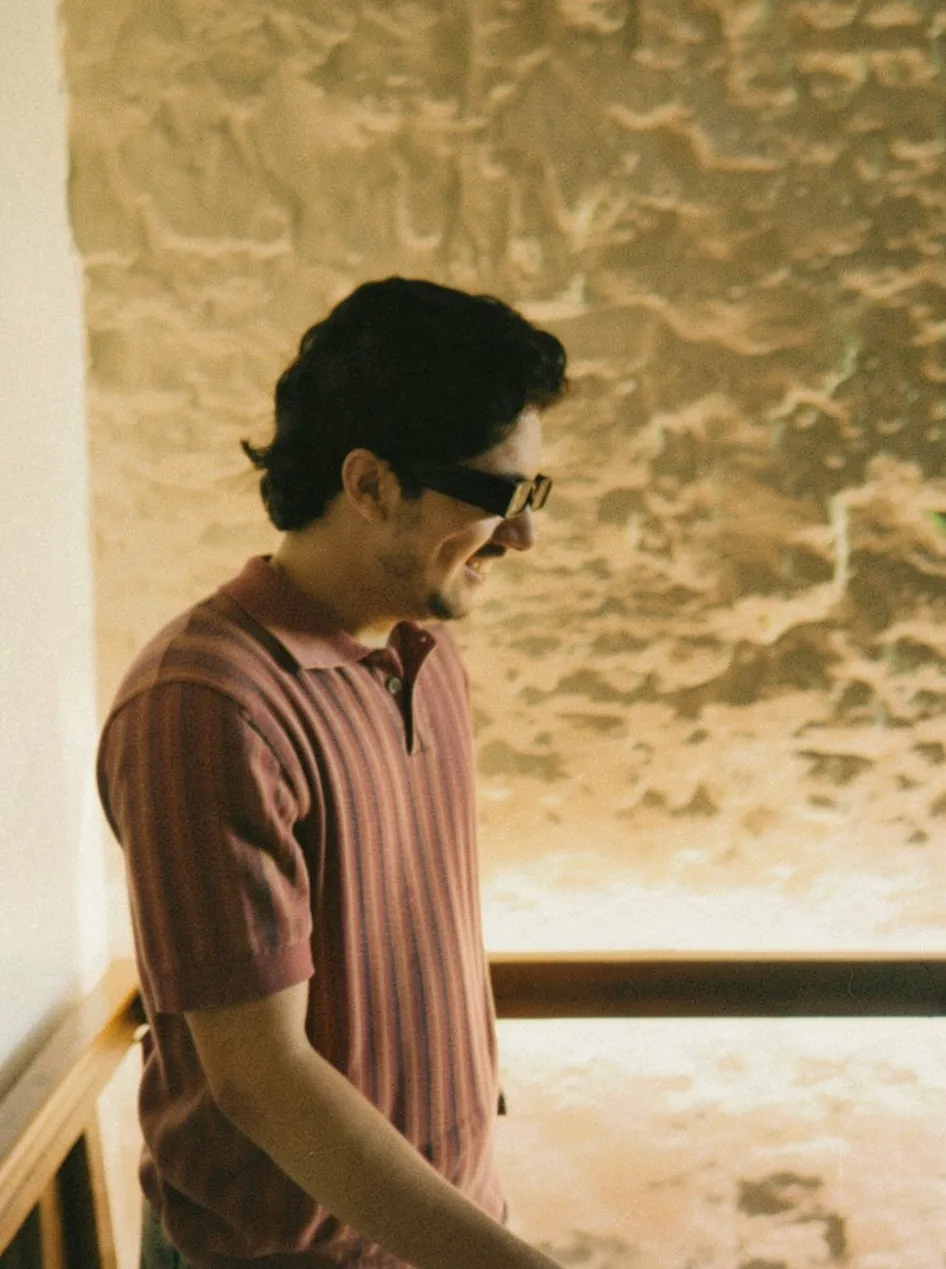
Hassan in a striped polo and sunglasses, smiling, in warm light

About

Hi, I’m Hassan. I studied computer science at NUST in Islamabad, shipped software in Lahore, then moved to Munich for a master’s at TUM and finished it with a thesis at Harvard Medical School. These days I live in Cologne.

My work sits where data engineering meets machine learning: pipelines that don’t break at 3 a.m., models that are useful outside a notebook, and lately agents that do real work for real teams. Off the keyboard I take photos, travel, and am slowly getting less bad at golf.

M.Sc. Data Engineering and Analytics
Technical University of Munich 2025
B.S. Computer Science
NUST, Islamabad 2019

Work

  1. 2026 – now

    Forward Deployed Engineer at KI performance

    Building agentic, multi-agent AI platforms for enterprise clients on Microsoft Azure.

    Microsoft Foundry · Azure OpenAI · Azure AI Search · Python · MCP

    Cologne

  2. 2024 – 2026

    Software Engineer at peopleIX

    Architected and owned the data and AI backend of an HR analytics platform: 50+ Airflow pipelines, multi-tenant Postgres models, a semantic metrics layer and the LLM stack behind its AI analyst.

    Python · Airflow · AWS · Azure OpenAI · PostgreSQL · LangGraph

    Cologne

  3. 2023 – 2024

    Graduate Researcher at Harvard Medical School

    Deep learning for tracker-less ultrasound guidance in neurosurgery: a texture-invariant keypoint descriptor that matches pre-op MR with intra-op ultrasound. Became my TUM thesis and a best-presentation paper.

    PyTorch · Computer Vision · Contrastive learning

    Boston

  4. 2023

    Co-Founder at MuseLabs

    A product mixing social media with e-commerce. Built the FastAPI backend on GCP and the Flutter app.

    FastAPI · GCP · Flutter

    Munich

  5. 2022 – 2023

    Software Engineer, Cloud Processing at NavVis

    Built the QA automation suite for release testing of the IVION Cloud Processing product.

    Python · Selenium · Robot Framework · C#

    Munich

  6. 2022

    Research Assistant at Fraunhofer IKS

    Constrained hierarchical reinforcement learning for safe robot navigation. Joint first-author paper at IEEE ICMLA.

    PyTorch · Reinforcement learning

    Munich

  7. 2020 – 2021

    Machine Learning Engineer at SlashNext

    ML pipelines for real-time phishing detection; a hash-based image method lifted detection on image data by 5%.

    PySpark · TensorFlow · OpenCV

    Lahore

  8. 2019 – 2020

    Software Engineer at Techlogix

    APIs and front-end for the web and mobile apps of a campus management product.

    Angular · Ionic · Flask

    Lahore

Research

Before agents and data platforms, I spent a few years in research labs. Most of it was one question: how do you match two images of the same thing when they look nothing alike? Along the way, a detour into keeping learning robots safe.

ASMUS @ MICCAI 2024First author

Best Presentation Award

Learning to Match 2D Keypoints Across Preoperative MR and Intraoperative Ultrasound
Hassan Rasheed, Reuben Dorent, Maximilian Fehrentz, Tina Kapur, William M. Wells III, Alexandra Golby, Sarah Frisken, Julia A. Schnabel, Nazim Haouchine

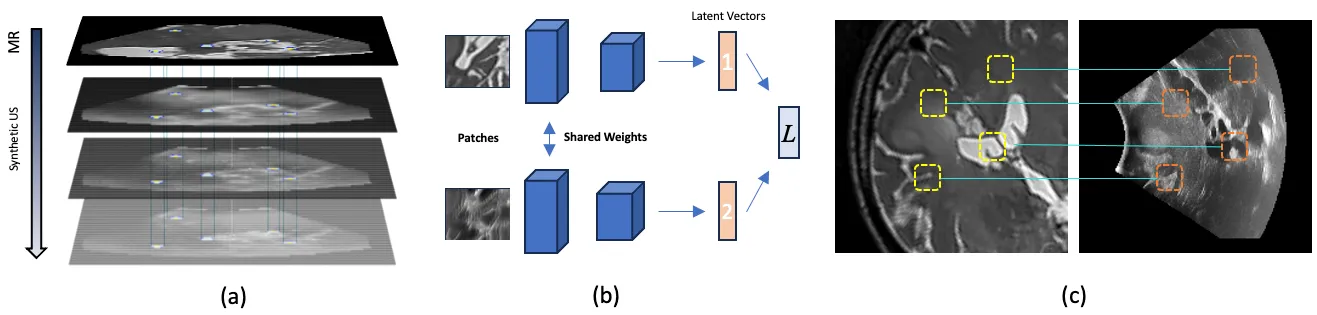
Method overview: (a) a stack of synthetic ultrasound images generated from one MRI slice, sharing the same keypoints; (b) a Siamese network with shared weights turning image patches into descriptor vectors trained with a contrastive loss; (c) keypoints on an MRI slice connected by match lines to the same points on an intraoperative ultrasound image.
(a) synthetic ultrasound generated from MRI, keypoints shared across the stack · (b) Siamese descriptor network trained with a contrastive loss · (c) matches between MRI and intraoperative ultrasound
The problem
During brain surgery the brain shifts, so the MRI taken beforehand stops lining up with reality. Ultrasound shows the current state, but it looks nothing like MRI: different texture, heavy speckle noise. Classic keypoint matchers find almost nothing in common between the two.
The idea
Matching by synthesis. From each patient’s MRI we generate many synthetic ultrasound images covering several MR contrasts and realistic ultrasound variation, so every keypoint has known correspondences. A Siamese network is then trained per patient with supervised contrastive learning to describe each keypoint by its structure, not its texture.
The result
On real clinical cases with ground truth from the ReMIND dataset, the descriptors reached 80.35% average matching precision, outperforming the state-of-the-art methods it was compared against.

My part Designed the descriptor and the synthesis pipeline, ran the experiments and wrote the paper. It became my TUM master’s thesis, done at Harvard Medical School / Brigham and Women’s Hospital.

Cite
@inproceedings{rasheed2024learning,
  title     = {Learning to Match 2D Keypoints Across Preoperative MR and Intraoperative Ultrasound},
  author    = {Rasheed, Hassan and Dorent, Reuben and Fehrentz, Maximilian and Kapur, Tina and Wells III, William M. and Golby, Alexandra and Frisken, Sarah and Schnabel, Julia A. and Haouchine, Nazim},
  booktitle = {Simplifying Medical Ultrasound (ASMUS 2024)},
  series    = {Lecture Notes in Computer Science},
  pages     = {78--87},
  publisher = {Springer},
  year      = {2024},
  doi       = {10.1007/978-3-031-73647-6_8}
}

MICCAI 2024Co-author

Intraoperative Registration by Cross-Modal Inverse Neural Rendering

Maximilian Fehrentz, Mohammad Farid Azampour, Reuben Dorent, Hassan Rasheed, Colin Galvin, Alexandra Golby, William M. Wells, Sarah Frisken, Nassir Navab, Nazim Haouchine

How do you find exactly where the surgical camera is, relative to the preoperative 3D scan, when the live image looks very different from the scan?

Split a neural radiance field into two parts: anatomy, learned before surgery, and appearance, controlled by a multi-style hypernetwork and adapted during surgery. The trained field becomes a differentiable renderer, and the camera pose is found by making its render match the intraoperative image.

“…the trained model is used as a differentiable rendering framework to estimate the surgical camera pose…”

Fehrentz et al., arXiv:2409.11983 (CC BY 4.0)

On retrospective clinical patient data it outperformed state-of-the-art registration methods while meeting current clinical standards.

My part Part of the same Harvard / BWH and TUM collaboration on cross-modal neurosurgical guidance.

Medical Image Computing and Computer Assisted Intervention, LNCS vol. 15006, pp. 317–327.

Cite
@inproceedings{fehrentz2024intraoperative,
  title     = {Intraoperative Registration by Cross-Modal Inverse Neural Rendering},
  author    = {Fehrentz, Maximilian and Azampour, Mohammad Farid and Dorent, Reuben and Rasheed, Hassan and Galvin, Colin and Golby, Alexandra and Wells, William M. and Frisken, Sarah and Navab, Nassir and Haouchine, Nazim},
  booktitle = {Medical Image Computing and Computer Assisted Intervention (MICCAI 2024)},
  series    = {Lecture Notes in Computer Science},
  volume    = {15006},
  pages     = {317--327},
  publisher = {Springer},
  year      = {2024},
  doi       = {10.1007/978-3-031-72089-5_30}
}

IEEE ICMLA 2022Joint first author

Safe Robot Navigation Using Constrained Hierarchical Reinforcement Learning

Felippe Schmoeller Roza, Hassan Rasheed, Karsten Roscher, Xiangyu Ning, Stephan Günnemann

Reinforcement learning agents learn by trial and error, which is a problem when an error means a robot crashing into something. How do you keep a navigating robot safe while it learns long, multi-step tasks?

Hierarchical RL splits navigation into a high-level planner that picks sub-goals and a low-level controller that reaches them. We added a safety layer that corrects the low-level actions so the robot stays inside a safe region.

In simulation, the constrained hierarchical agent kept its task performance better than a constrained flat agent while staying in the safe region.

My part Compared hierarchical RL methods and built the constrained hierarchical policy with the safety layer, at Fraunhofer IKS in Munich.

21st IEEE International Conference on Machine Learning and Applications, Nassau, Bahamas, pp. 737–742.

Cite
@inproceedings{roza2022safe,
  title     = {Safe Robot Navigation Using Constrained Hierarchical Reinforcement Learning},
  author    = {Schmoeller Roza, Felippe and Rasheed, Hassan and Roscher, Karsten and Ning, Xiangyu and G{\"u}nnemann, Stephan},
  booktitle = {21st IEEE International Conference on Machine Learning and Applications (ICMLA)},
  pages     = {737--742},
  publisher = {IEEE},
  year      = {2022},
  doi       = {10.1109/ICMLA55696.2022.00123}
}

Master’s thesis: Cross-Modal Medical Image Matching via Synthesis, TUM, carried out at Harvard Medical School / Brigham and Women’s Hospital (Surgical Planning Lab), 2024. Data: the public ReMIND brain-resection imaging database.

Projects

Everything else lives on github.com/hassanrasheedk.

Photos

Phone photography from places I’ve lived and passed through. More on Instagram.

Writing

All writing

Say hello.

Working on something with data, ML or agents, or just want to talk photos? My inbox is open.

Message me on LinkedIn